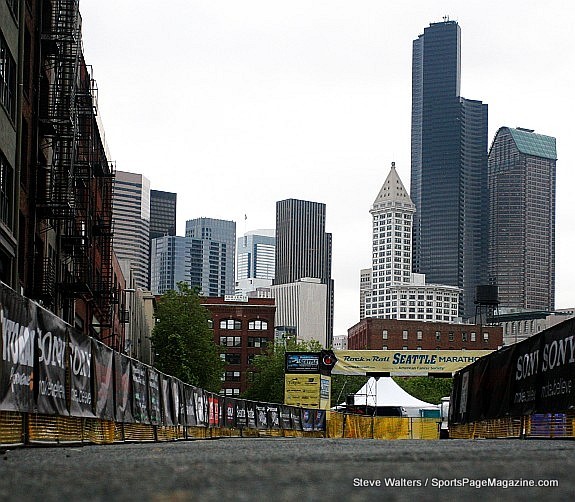
(This recap will be separated into two parts: The actual race and everything else. You can click through to Part II
HERE)
Traveling is usually a stressful experience. Traveling with kids, even more so. Traveling with kids to run a marathon probably isn't the brightest idea ever. However, with the help of my mother-in-law who came to visit/help from Las Vegas, my wife and I were both able to participate in the Seattle Rock 'n' Roll Marathon and 1/2 marathon. My kids were troopers, Grandma was entertaining and our weekend activity plan was executed smoothly (although we almost had an bathroom emergency on the light rail on Friday - when a 4-year old needs to go to the bathroom, being on or near the Seattle light rail is not a good thing - there are no bathrooms ANYWHERE, including the stations. Thank goodness for Macey's).

I met the 3:45 pace leader (Steve) in corral #6 and tried to get an idea of how this was going to work. Was he going to run a negative split, an even pace or run different paces throughout the race? There was a handful of people hanging around near Steve and determined this would be my running group for the next few hours. After a good effort by a young lady on the national anthem, the elite runners set off and the rest of us walked towards the start line, each corral being sent out approximately 90 seconds apart. (Note: Pictures were literally taken on the run, so some of them are a little blurry)
Miles 1-4
The first few miles were all about getting comfortable and not tripping over anyone else. Our pace was the same as the 1:52 half marathon pace group, which had 15-20 people running together, so it was pretty congested for a while. We came upon the first band and aid station, made a turn onto Martin Luther King Jr Way and gradually made our way towards the waterfront of Lake Washington. The pace felt comfortable, though I was dismayed when we passed the 1 mile marker and my Nike+ sportband read 1.10 miles. Great, I thought, I'm already off by 10%. I logged a 5k time of 26:20, but the crowd of runners all around was starting to get to me. I had been running right with Steve, but we were about 45 seconds behind where he wanted us to be.
Miles 4-9

In the 5th mile we encountered our first hill. As some people slowed down, Steve started navigating his way through the crowd and I followed him. At mile 6 I got through the aid station faster than Steve, the rest of our group and the entire 1:52 group and suddenly felt the freedom of running with a little bit of space around me. Pleased with this feeling, I ran free and loose, increasing my distance from Steve little by little and clocked in at the 10k mark at 53:18. These miles were some of the most scenic of the entire course. Lake Washington was to our right and lining the roads were large green trees, lots of green grass and large waterfront homes on our left. Out in the distance the bridge to Mercer Island could be seen. Soon enough we would be on the bridge. I occasionally looked back to see where Steve was but must have let my mind wander for a mile or so because around mile 8 I looked again and he was directly behind me. I was running a consistent pace, but he must have sped up to get back on pace. Whatever the case, psychologically it was a little jarring and I felt the pressure of trying to keep up instead of the free and loose feeling I had enjoyed for the previous few miles.
Miles 9-13

Just past mile 9 (where my time registered as 1:17:14), the marathoners split from the half runners and ran a 2 1/2 mile out and back across Lake Washington. It was a bit windy and each side of the bridge was slightly uphill. Keeping up with Steve was getting more difficult and all but myself and one other runner had fallen back off the pace. After rejoining the half runners in the I-90 expressway tunnel we emerged to a view of Downtown Seattle, including our first view of Quest Field. Miles 12 and 13 continued on I-90 towards the downtown area. It was nice to be separated from the half runners for all of these miles. I could tell they were much more bunched up than we were. I did all I could to keep up with Steve, but as we crossed the 13.1 marker (1:53:02), I had to slow my pace. I was still feeling good but needed to back it off for a little while.
Miles 13-17

There wasn't much by way of spectators on the highway itself, but as we excited and ran into downtown the cheering of the crowd was inspiring. People were yelling, bells were ringing, I even saw a few cowbells. It felt like we were running down a parade route. At mile 14.5 I came upon a guy running by himself that looked about the same age as I am. I asked how he was doing, he answered he felt terrible. He said it was his first marathon and asked if I had done this before. We talked for a bit as we ran through town towards the Alaska Way Viaduct. His goal was 4 hours and I offered him the encouragement that if he kept his current pace through the next 5 or 6 miles, he'd make it (I also told him the next 5 or 6 miles were going to suck, but running the last 5 or 6 would feel pretty cool). We entered the Battery Street Tunnels around mile 16 and emerged shortly thereafter onto Aurora Avenue. The next 5 miles were the most difficult of the entire course.
Miles 17-22

I had mentally and physically prepared myself for hills. I ran many miles worth of hills in the weeks leading up to Saturday. To run up Aurora Avenue and see the hill that awaited me was not something I was prepared for, however. It was long and it was brutal. I kept telling myself to pick up my knees and let my body just fall forward from step to step and it seemed to work. I maintained a fairly even, if slow, pace up the hill. About halfway up was an aid station where a volunteer was holding a big bucket of gummy bears. Any other time, I wouldn't think twice about turning them down. I think they are nasty. But on this day, at this time, I remembered how badly I had wanted something, anything, with flavor in the latter miles of the Newport Marathon, and so I opted for a handful of chewable bears. They tasted so good and I tried to savor them as long as possible while trying not to inhale them into my lungs. I passed the 30k marker at 2:45:48 and knew I still had a great shot at finishing under 4 hours. The climb continued until I saw two things that, at this point, made my day. First, a condo complex named "The Summit." I figured this must be indicating we had made it to the top. Second, a lady holding a sign which read: "Dear Complete Stranger - I don't know you, but I'm proud of you." Never were kinder words written or conveyed on a marathon banner.
At the turnaround mark at 18.5 miles we got to see the descent we had just enjoyed after our tough climb. Truth be told, I don't remember any descent after our tough climb. But it certainly must have been there, because we were going to climb back up to the top of it. I continued my slow even pace to the top and began my descent back towards the Battery Street Tunnels. At mile 20 I was struck by the scene on the other side of the road, of those climbing the first hill. Grown men were off to the side of the road in tears. Athletic looking 20-somethings tried to stretch, massage and rub all sorts of muscles, as they looked up the hill in seeming despair. Others were walking slowly, their heads down, some muttering words of encouragement to themselves, others expressing disappointment in what was transpiring. I started to think about the marathon and what it does to the body and mind. Quite literally it beats you up and breaks you down to nothing. Mentally, physically, perhaps psychologically, the toll of the miles, the hills, the energy exerted, the thought of all of the preparation put in and all of the other experiences that occur in those few hours push the body to its limits (and sometimes passed) as to what it can endure. I know what those people were feeling. I felt it three weeks ago at almost the exact same point in the race. It's not a good feeling. It is the feeling of fear--fear that perceived failure is becoming a reality and there's seemingly nothing you can do about it. If I learned anything from Newport, it's that these are the kind of thoughts you can't even begin to allow yourself to think or they will destroy whatever shred of confidence you may have left.
I looked at my watch and knew if I could just maintain pace for another 6.2 miles, I would finish in under 4 hours. 6.2 miles - just a 10k I told myself.
Miles 22-26.2

The camber of the road inside the Battery Street Tunnel was terrible and there was no relief from it, even on the tiny sidewalks lining the road. It put my left foot far above my right, and after 22 miles this caused some pretty significant pain in my left hip (and even more pain the following day). We came out of the tunnel and back on the Alaska Way Viaduct, this time on top (on the way out we were on the lower portion) and got another look at Quest Field. At mile 23 we passed the turnoff to the finish line and could see lines of people in both races running the final 1/2 mile to the finish line. They looked like a line of ants all following each other down the ramp around the 180 degree corner and towards the finish line. I heard many people complain how terrible it was for us to have to run past the off ramp and still have three more miles still to go, but I didn't care. I had slowed my pace significantly at this point but I had not walked yet, with the exception of a few water stations. I wasn't going to walk through them, but I decided during the 2nd half of the race that it was more important to get nice relaxed sips of water (and Cytomax) than it was to slosh them up towards my face and hope I got what I needed as I continued to run.
At the 24 mile mark (3:42:00) my run slowed to a walk. Not a slow walk like in Newport, it was definitely a walk with a purpose, but it was a walk nonetheless. This lasted just a short time and then I got going again and ran to the next aid station at 24.5 miles. I employed the run/walk strategy for the next two miles, which included a 4-story climb back to the top of the Viaduct at mile 25. At 25.5, at long last, we made a sharp right turn and ran town the ramp to street level for the final 1/2 mile. At the bottom of the ramp spectators were in abundance and were cheering loudly as they waited for us weary runners to pass by. We made a left turn through a parking lot and then another left onto Occidental Avenue, where for the first time we could see the actual finish line, just a few hundred yards in front of us. The spectators lining both sides of the street 4 and 5 people deep behind the police barricades willed us on and everyone around me, myself included, started running just a little bit hard as we ran for home.
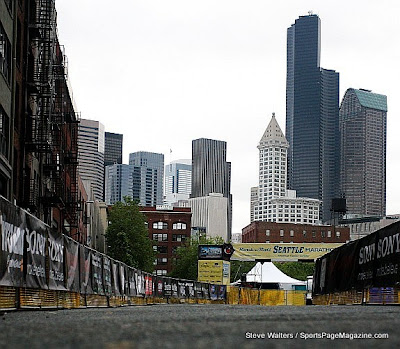
I crossed the line in 4:07:22 and knew that I had done all I could do. I had no regrets and no disappointments. My time is still a bit slower than I would like but it improved by 27 minutes from Newport. I was better prepared, however, mentally and physically. I was beat up but I was smiling. I would live to run another day and I would enjoy it. My wife, dad, mom and sister were in the finishing area waiting for me (they had all run the half marathon) and it was a nice moment for all of us.
Final Thoughts
I'm not sure where I go from here. In order to run another marathon (Saturday races only) and to do so somewhat economically, I probably have to venture to Idaho (
Pocatello (9/4/10)) Utah (
Park City (8/21/10),
Top of Utah (9/18/10),
Layton (10/9/10)) or Nevada (
Mesquite (11/21/10)), but none of these races are for a few months and all of them are at significantly higher elevations. Unfortunately there aren't very many half marathons in my area either so I don't know what to do. I'm taking it easy this week but I need to find another race to run. Yes, I'm addicted to running. I need a purpose though. Something to put on my calendar and train for.

There's a 24-rule in my house: Anything I say about running within 24 hours of finishing a marathon is not to be taken seriously. Today is Tuesday and I feel fine. Tomorrow I'll venture out for a few miles and see how I feel. Saturday I'll probably run between 14 and 16 miles, maybe more. On Sunday I turn 28 years old. If I had told my then-turning 27-year old self a year ago that I would run two marathons before I was 28, well, you can guess how that would have been received. But I'm here and I love it.
I thank all of you for all of your support and for following this blog, however long you've been doing so. This site will probably be undergoing some changes in the next few weeks so don't be shocked if information or pages disappear and reappear at random times. My goal is to post something informative at least once a week (less of me; more training and preparation strategies), so keep checking back.
Until then, happy running.